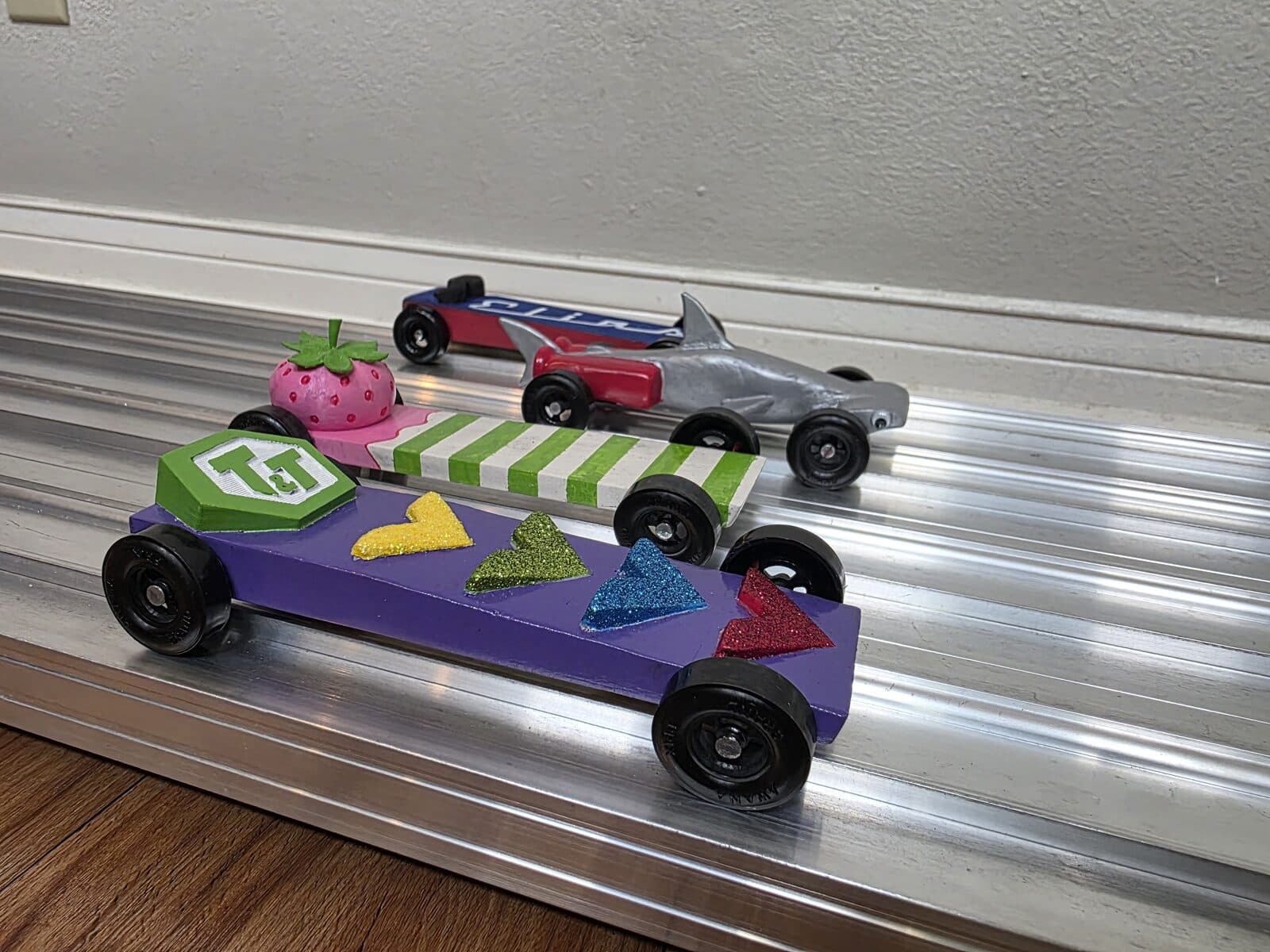
The format you pick is the single biggest decision shaping how your race feels. Most disputes don't come from bad timing. They come from a format that made one kid feel like they didn't get a fair shot.
Here's the quick comparison. Then the details.
At a glance
| Format | How it works | Best for | Cost |
|---|---|---|---|
| Single-elimination bracket | Two cars race, winner advances, loser is out. | Small fields, two-lane tracks, paper-only operation. | Half the kids race once and lose. Lane bias decides close matchups. |
| Double-elimination bracket | Two losses to be out. Winners and losers brackets. | Same as single-elim but a little more forgiving. | Still ends early for many kids. Bracket logistics get complex fast. |
| Heat rotation (Perfect-N, Stearns, chaotic) | Every car races in every lane. Total time wins. | The default for any modern pack with software. | More heats. Requires summing times across rounds. |
| By-den / by-rank grouping | Race within den first, top finishers advance to pack final. | Packs where den identity matters and dens have 6+ cars. | Small dens make den-level racing anticlimactic. |
The short answer for most first-time chairs: heat rotation across the full pack, with a championship round at the end for the top finishers. It's what your software is built for, and it's what most modern packs run.
The rest of this post explains why, and when the other formats are the right call.
Part of a series. This pairs with the free planning checklist for first-time pack chairs.
Bracket racing
Bracket racing is the format most people picture when they hear "tournament." Two cars race. The winner advances. The loser is out (single-elim) or moves to a consolation bracket (double-elim). Eventually two cars meet in the final.
Where it shines. Easy to explain. The final heat genuinely feels like a final. Parents and kids understand it instantly. If you don't have software or a spreadsheet to run a more complex format, it's the honest fallback.
Where it breaks. Two problems, and they're both serious.
First, single-elimination eliminates half the field after one heat. A kid who spent three weekends building a car with their parent gets one race, loses by a tenth of a second, and watches the rest of the event from the bleachers. Double-elimination softens this but doesn't fix it — the bottom of the bracket still cycles out fast.
Second, bracket racing assumes lanes are equivalent. They're not. Every track has a fastest lane and a slowest lane, sometimes by enough to flip a close matchup. A kid who draws the slow lane in their one and only heat has been disqualified by a coin flip. This is the deeper unfairness, and it's the reason heat rotation exists.
Pick bracket if: you have two lanes, a small field (under 12 cars), and no software. Otherwise, keep reading.
Heat rotation
Heat rotation is what most modern pack races run. Every car races in every lane against a rotating set of competitors. Lane bias cancels out across the rotation. Total time (or total points) determines the winner.
You don't have to design the rotation yourself. Derby scheduling has been a solved problem for years, and there are well-known patterns named after the people who worked them out.
The rotations you'll hear about:
- Stearns method. The classic. Each car races in each lane once. Simple to lay out on paper for small fields.
- Perfect-N (Cory Young, John Pope). Every car races in every lane the same number of times and faces every other car the same number of times. The gold standard for fairness. Doesn't work with every combination of cars and lanes, which is why...
- Partial Perfect-N. A flexible variant that works for almost any combination. What most software defaults to.
- Chaotic rotation. Groups cars and runs each car several times in different lanes. Less mathematically perfect but easy to implement and still fair enough for a pack race.
Your race software picks one of these for you. You almost never need to know which beyond "yes, every car will race in every lane." That's the part parents care about.
Where it shines. Lane bias becomes irrelevant. Every kid races multiple heats and stays engaged for the whole event. The result actually reflects which car was fastest, not which car got lucky.
Where it costs you. More heats. A 20-car field on a four-lane track runs at least 20 heats just to give every car one turn in every lane — typically 60–75 minutes of pure racing once you account for reset time. Larger fields run longer.
It also requires real software (or a meticulously prepared spreadsheet) to track times across heats and sum them. You cannot run heat rotation with a clipboard.
Pick heat rotation if: you have three or more lanes, software running the schedule, and a field of 12 or more cars. That covers most modern pack races.
Recovering the drama. Heat rotation produces a winner from accumulated times, not from a final heat. Some packs find this anticlimactic. The fix is a championship round — the top four or six finishers race a final set of heats at the end for the trophy. Same fairness, plus the dramatic final.
By-den grouping
Here's the part where chairs get confused. By-den racing isn't a third format. It's a grouping decision you layer on top of either bracket or heat rotation.
A by-den structure means cubs race their den first (Lions vs. Lions, Tigers vs. Tigers, and so on), and then the top finishers from each den advance to a pack-wide final. Within each den, you can use either bracket or heat rotation. Same for the final round.
You'll see by-den called a "format" in plenty of guides. It's not — it's a way to organize who races whom, not how the racing decides a winner. Worth knowing because if you treat it as a third option, you'll skip the actual decision (bracket vs. rotation), which still has to be made within each den.
Where it shines. Younger cubs aren't racing older cubs whose cars tend to be faster. Every den produces its own champion, which means more kids walk away with recognition. Some pack cultures value den identity strongly enough that this matters more than the pack-wide racing.
Where it costs you. Small dens make the den-level race feel thin. With three or four cars per den, a den-level rotation is over in five minutes and feels anticlimactic. The pack final compresses to a handful of cars, which shortens the most dramatic part of the day.
There's also a sneaky math problem: heat rotation doesn't always work cleanly with small fields. Some Perfect-N configurations need a minimum number of cars. With three or four cars in a den, you may end up doing partial rotations that reintroduce some lane bias — exactly the problem rotation was supposed to solve.
Use by-den if: your dens have eight or more cars each and den identity is a real part of your pack culture. Otherwise, race the full pack together and recognize den-level finishers in the awards.
Practical constraints
Three numbers actually decide what's possible: lane count, field size, and time budget.
| Setup | Recommendation |
|---|---|
| 2 lanes, any field | Bracket. Heat rotation is technically possible but takes too long. |
| 4 lanes, 12–25 cars | Heat rotation across the full pack. Adds up to 60–90 minutes of racing. |
| 4 lanes, 25–45 cars | Heat rotation with by-den grouping (if dens are big enough), or a championship round at the end to compress the final. |
| 4 lanes, 45+ cars | By-den grouping is almost mandatory. Otherwise the race runs over two hours. |
| 6 lanes, any field | Heat rotation. Fewer rotations to cover every car in every lane — fastest format you can run. |
The general rule. More lanes favor heat rotation. Fewer lanes favor brackets. Larger fields almost always benefit from heat rotation because the lane-bias problem gets worse the more cars race once.
What to do next
Pick the format deliberately, then publish it with the rules before registration opens. A parent who knows their kid is racing four heats in a rotation has different expectations than one who showed up expecting a single-elimination bracket. Setting the expectation up front prevents most format-related disputes.
The good news: heat rotation is the default for almost every pack-race software setup, including this one. Pick it, hit "generate schedule," and the rest is mechanical.
Working through the rest of your race planning? Grab the free planning checklist →